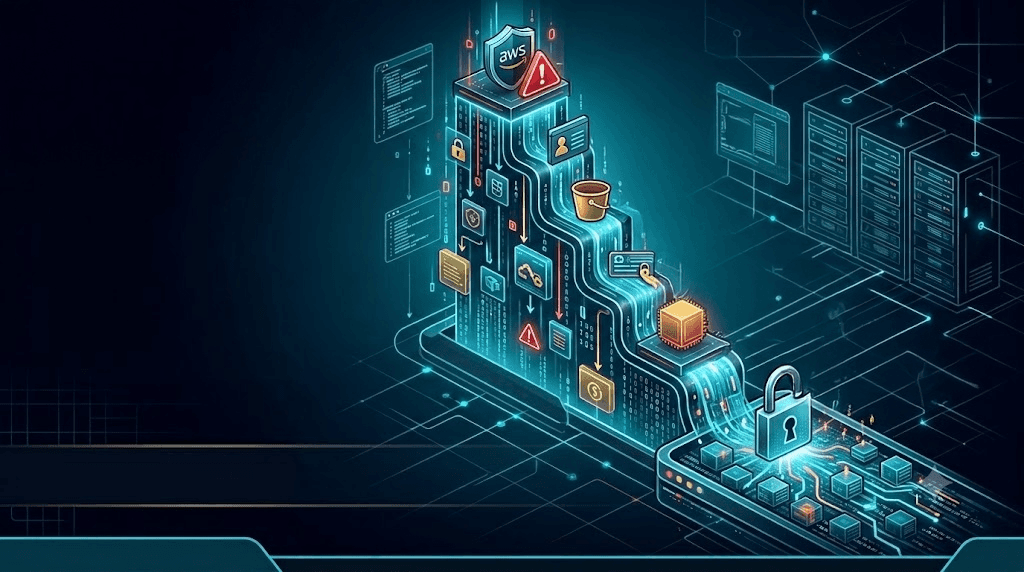
The IAM Cascade: How a Minor AWS Misconfiguration Exposes Your App’s Entire Database
Modern application development is fast, exciting, and increasingly interconnected. A few years ago, an engineering team might have built everything inside a single cloud environment. Today, it’s a multi-cloud world. An application might run its core infrastructure on AWS, orchestrate code deployment via GitHub Actions, and call the Claude API for cutting-edge AI features.
While this “best of breed” approach helps teams build quickly, it introduces a hidden vulnerability. In forums like Hacker News and r/devops, engineers frequently cite cross-platform permission management as a persistent pain point. When security policies are stretched thin across multiple ecosystems, tiny blind spots emerge.
At Red Sentry, our cloud pentesting team routinely sees how these blind spots turn into major data breaches. Below is a step-by-step explanation of how a seemingly minor misconfiguration can trigger a cascading failure that exposes an entire production database.
The Multi-Cloud Blind Spot: Where Automated Security Tools Fall Short
Many organizations rely on Cloud Security Posture Management (CSPM) tools to monitor their environments. These tools act as automated security guards, scanning your cloud infrastructure for common mistakes, like an open database port or a publicly accessible storage bucket.
However, standard CSPMs have a significant structural limitation: they evaluate cloud environments in isolation. They check your AWS configuration, then separately check your Google Cloud or Azure setup. What they cannot see is the cross-platform logic, the dependencies, and access pathways that connect those environments to external services.
If an attacker gains a foothold in a minor microservice, a CSPM is unlikely to flag it as a critical issue if that microservice appears locked down within AWS itself. It cannot understand how a permission inside AWS interacts with an external service like GitHub or a third-party API. This gap in contextual visibility is precisely what sophisticated attackers look for, and it sets the stage for everything that follows.
The Starting Point: An Overly Permissive IAM Role
Every cloud attack starts somewhere. In this scenario, the entry point is not your core database or your most sensitive service; it is a minor, low-priority microservice, perhaps an internal tool that generates weekly PDF reports. Because it is deemed “low risk,” security oversight is more relaxed.
When configuring this service, a developer encounters restrictive permission errors and, under time pressure, resolves them by assigning a more generous Identity and Access Management (IAM) role. IAM is the framework that governs which software, users, and services can access specific resources within a cloud environment.
Instead of granting the microservice only the narrow permissions it needs, such as write access to a single storage bucket, the developer inadvertently grants it broad read and write permissions across a much wider slice of the AWS environment. Nothing appears broken from the outside. The service works as expected. But the conditions for a cascading failure are now in place.
From Microservice to Code Repository: Expanding the Attack Surface
Once an attacker discovers and exploits a vulnerability in that minor microservice, they gain the effective identity of that permissive IAM role. They are now operating inside the AWS environment with trusted credentials. At this stage, a careful attacker does not immediately attempt to access the database—that would likely trigger alerts. Instead, they look for ways to expand their access and understand the broader architecture.
Many cloud applications use continuous integration and delivery (CI/CD) pipelines managed through platforms like GitHub. To automate deployments, AWS and GitHub must communicate with each other, which requires the exchange of access keys and tokens. These credentials are typically stored in environment variables or cloud configuration services.
By leveraging the IAM permissions inherited from the compromised microservice, the attacker can read those environment variables and connection strings. This pivots their access from a minor cloud service into the company’s code management platform. At this point, the attacker has a detailed map of the entire application architecture, and critically, the CSPM still sees nothing unusual, because each component appears to be operating normally.
Extracting Third-Party Credentials: The Claude API as an Attack Vector
With visibility into the broader environment and code configuration, the attacker begins identifying high-value targets. In modern applications, these are often third-party integration services that the application communicates with via API keys or tokens.
Consider an application that uses Anthropic’s Claude API to power an AI chatbot. To make API calls, the application requires secret keys, which are typically stored in a cloud configuration vault or secrets manager. Because the attacker is already operating with trusted internal credentials, they can retrieve those keys directly.
The implications extend beyond simple API abuse. With valid API credentials, the attacker can impersonate the application externally, potentially accessing proprietary data processed by the AI service or using the trusted API connection as a channel to exfiltrate information without triggering standard network-level alerts. Once again, the CSPM has no mechanism to detect this—the outbound API calls look identical to those made by the legitimate application.
The Final Step: Accessing the Production Database
By this stage, the attacker has bypassed the network perimeter, mapped the infrastructure through GitHub access, and extracted third-party credentials, including API keys. They now have a thorough understanding of how data flows through the entire ecosystem.
The final step is locating the production database. In a properly configured environment, this would be the most heavily guarded resource. But because the attacker is now presenting trusted, internally consistent credentials harvested at each stage of the cascade, they do not appear to be an intruder; they appear to be a legitimate component of the application stack.
Using that trusted status, the attacker requests a database backup or directly queries the tables, extracting names, credentials, financial records, or intellectual property. The entire cascade, from the initial foothold to this final extraction, may have unfolded over days or weeks, well below the detection threshold of automated tooling. By the time the breach is discovered, the data is already gone.
Protecting Your Ecosystem with Cloud Pentesting
This entire chain of events does not require a sophisticated zero-day exploit. It relies on a combination of human error and an attacker patient enough to follow the chain: a single developer trying to move fast, a slightly over-permissive IAM policy, and automated security tooling that evaluates each environment in isolation rather than understanding the relationships between them.
Preventing the IAM cascade requires a holistic view of security, one that accounts not just for what is configured within AWS, but also for how AWS interacts with your code repositories, deployment pipelines, and third-party APIs.
This is where intentionally scoped pentesting, risk assessment, and cloud configuration reviews can provide insight that simple automated tooling will miss. At Red Sentry, our assessments go beyond automated checklist review by manually validating high-risk misconfigurations, IAM weaknesses, exposed services, insecure storage, logging gaps, and access-control issues within the agreed scope. When CI/CD pipelines, code repositories, third-party integrations, or broader attack-path validation are explicitly included, our testers can also evaluate how these connected systems may create escalation paths that automated tools often miss.
Secure your interconnected cloud environment today
Our expert cloud pentesting team mimics real-world adversaries to uncover the hidden cross-platform pathways that standard security tools completely miss. We trace your permissions from AWS to GitHub and your third-party APIs to ensure your production database remains locked down. Get a quote now!
The IAM Cascade: How a Minor AWS Misconfiguration Exposes Your App’s Entire Database
The IAM Cascade: How a Minor AWS Misconfiguration Exposes Your App’s Entire Database
Jun 10, 2026