Securing the Pipeline: Why Standard Monitoring Fails Your Claude and OpenAI APIs
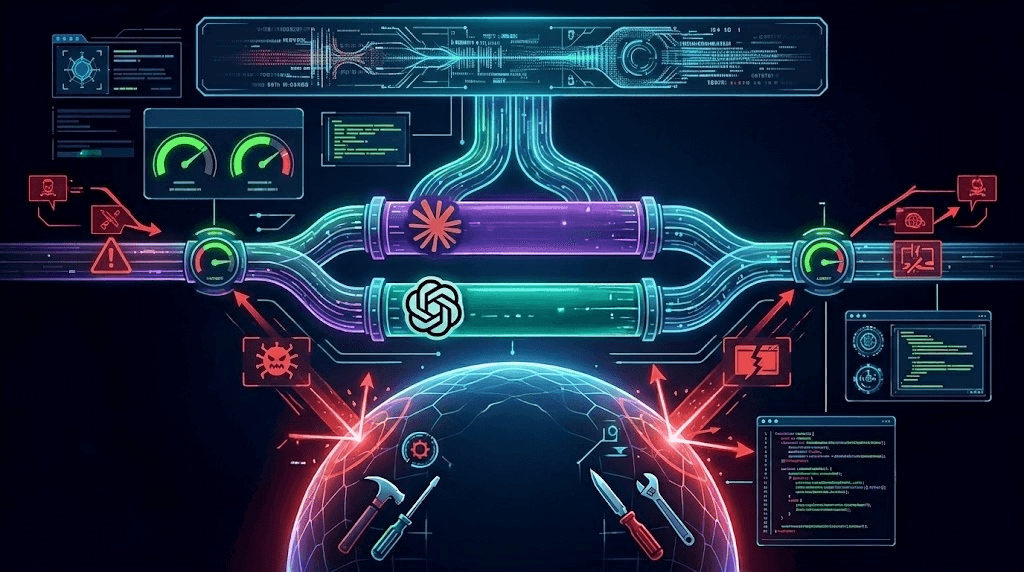
Securing the Pipeline: Why Standard Monitoring Fails Your Claude and OpenAI APIs
Securing the Pipeline: Why Standard Monitoring Fails Your Claude and OpenAI APIs
The integration of Large Language Models (LLMs) like Claude and OpenAI into the modern enterprise application stack has moved at a staggering pace. DevOps teams, tasked with maintaining uptime and basic security, are frantically attempting to secure and monitor outbound LLM connections. The objective is clear: prevent prompt injections, thwart data scraping, and stop compliance violations before they hit production.
However, a dangerous architectural blind spot has emerged. DevOps pipelines rely on traditional monitoring architectures, like standard APMs, log aggregators, and network firewalls, to protect these pipelines. But these systems are fundamentally unequipped for the era of generative AI. Standard logging tools don't understand context. When an application interacts with an LLM, the vulnerabilities shift from rigid syntax errors to fluid semantic manipulation.
To protect your enterprise, you must look past basic uptime metrics and understand why standard monitoring fails your AI assets, and how specialized API pentesting secures the new AI attack surface.
The Context Blindness of Traditional APMs
Traditional monitoring tools look at the world through metadata, status codes, and structural schemas. They tell you if an API endpoint is responsive (HTTP 200), track latency, and flag malformed JSON strings.
When it comes to monitoring Claude API or OpenAI workflows, these systems are effectively blind. An attacker executing an indirect prompt injection attack isn't breaking your API schema. The JSON payload is perfectly valid, the connection is encrypted via TLS, and the server returns a successful HTTP 200 response.
Because standard logging tools cannot interpret the semantic context of the prompt or the model's output, they will happily greenlight a transaction where a rogue user successfully instructs Claude to bypass its system prompt and dump proprietary corporate data. Without context-aware inspection, your monitoring suite is just documenting your exploitation in real time.
Architectural Vulnerabilities at the AI-Cloud Intersection
Securing an LLM pipeline isn't just about analyzing input text; it’s about securing the intersection of application logic, cloud architecture, and third-party APIs. When developers hook LLMs into corporate infrastructure via Retrieval-Augmented Generation (RAG) or autonomous agents, they open unique structural vulnerabilities:
Data Exfiltration via AI Orchestration: If an LLM has access to internal databases (via plugins or vector embeddings), an attacker can use a prompt injection to force the LLM to search for sensitive data, bundle it, and leak it to an external server via open inbound/outbound application functions.
SSRF via LLM Agents: Autonomous agents that can fetch URLs on behalf of a user can be tricked into scanning internal cloud metadata endpoints, leading to full cloud infrastructure compromise.
Traditional web application firewalls (WAFs) filter out known SQL injection strings or cross-site scripting (XSS) scripts, but they fail to recognize an architectural logic attack wrapped inside a conversational prompt.
Understanding the Top LLM Security Risks
To build a robust defense, security, and DevOps teams must understand the specific LLM security risks threatening their systems, as defined by frameworks like the OWASP Top 10 for LLMs:
Prompt Injection (Direct & Indirect): Attackers manipulate the LLM’s behavior via user inputs or through untrusted third-party data ingested by the model (e.g., a poisoned webpage or document).
Insecure Output Handling: When applications blindly trust LLM outputs and pass them directly to system shells, databases, or browsers, creating downstream vulnerabilities like XSS or remote code execution.
Sensitive Data Disclosure: The accidental exposure of proprietary intellectual property, PII, or internal system architectures within the prompt history or model completions.
Because these risks evolve constantly based on natural language variations, static security rules and regular expressions are inherently useless at stopping them.
The Limitations of Basic API Guardrails
In an attempt to mitigate these threats, many development teams deploy inline API guardrails or open-source wrapper tools designed to screen prompts for forbidden keywords or toxic language. While guardrails are an essential layer of a defense-in-depth strategy, relying on them as a silver bullet creates a false sense of security.
Sophisticated adversaries easily bypass standard guardrails using token-smuggling, base64 encoding, hyphenation, or roleplay jailbreaks. If your security posture assumes that a lightweight prompt-filtering wrapper will block determined attackers, your application logic remains exposed. True security requires deep architectural assessment, continuous observation, and proactive testing.
Why Continuous API Pentesting is the Ultimate Answer
If standard monitoring fails to spot semantic context, and basic guardrails can be bypassed, how do you validate the security of your Claude and OpenAI integrations? The answer lies in rigorous, context-aware API pentesting.
At Red Sentry, we know that securing modern applications requires looking at the entire pipeline. Our Cloud pentesting solutions simulate real-world adversaries to find the vulnerabilities hidden at the intersection of your application logic, cloud environments, and AI APIs.
Instead of waiting for an attacker to exploit a blind spot in your AI integrations, pentesting actively pushes the boundaries of your API guardrails, tests your RAG data flows for exfiltration vectors, and ensures your monitoring infrastructure catches anomalous semantic behavior.
Secure Your Infrastructure from Every Angle
Don't wait for a breach to discover gaps in your cloud architecture or application logic. Get a transparent, tailored estimate for your security needs today.