
Manufacturing
Penetration Testing for Manufacturing Companies
Manufacturing companies face ransomware gangs targeting production lines, nation-state actors stealing IP, and attackers who exploit connections between IT and operational technology.
Manufacturing
Penetration Testing for Manufacturing Companies
Manufacturing companies face ransomware gangs targeting production lines, nation-state actors stealing IP, and attackers who exploit connections between IT and operational technology.
Why Manufacturing Companies Are Targeted
Manufacturing is the most attacked industry for ransomware, representing 25% of all incidents in 2024. The average manufacturing ransomware attack causes 21 days of downtime and costs $1.97 million. Attackers know manufacturers will pay to avoid production shutdowns and can't tolerate extended outages without massive revenue loss.
OT/IT convergence creates new attack paths
Connecting factory floors to corporate networks for efficiency and monitoring opens industrial control systems to internet-based attacks. Once attackers compromise IT systems, they pivot to SCADA, PLCs, and HMIs controlling production lines.
OT/IT convergence creates new attack paths
Connecting factory floors to corporate networks for efficiency and monitoring opens industrial control systems to internet-based attacks. Once attackers compromise IT systems, they pivot to SCADA, PLCs, and HMIs controlling production lines.
IP theft targets R&D and product designs
Nation-state actors and competitors steal CAD files, manufacturing processes, supplier lists, and proprietary formulas. A single breach can eliminate years of competitive advantage and cost millions in lost market position.
IP theft targets R&D and product designs
Nation-state actors and competitors steal CAD files, manufacturing processes, supplier lists, and proprietary formulas. A single breach can eliminate years of competitive advantage and cost millions in lost market position.
Legacy industrial systems can't be patched
Manufacturing equipment has 20-30 year lifecycles but runs outdated control systems and embedded software. Many PLCs and HMIs run Windows XP or custom operating systems with no security updates available. These systems remain connected to networks with unfixable vulnerabilities.
Legacy industrial systems can't be patched
Manufacturing equipment has 20-30 year lifecycles but runs outdated control systems and embedded software. Many PLCs and HMIs run Windows XP or custom operating systems with no security updates available. These systems remain connected to networks with unfixable vulnerabilities.
Remote access is poorly secured
Manufacturers provide vendors and technicians remote access to equipment for maintenance and troubleshooting. These connections often bypass security controls, use default credentials, or lack multi-factor authentication, creating backdoor entry points.
Remote access is poorly secured
Manufacturers provide vendors and technicians remote access to equipment for maintenance and troubleshooting. These connections often bypass security controls, use default credentials, or lack multi-factor authentication, creating backdoor entry points.
Why Manufacturing Companies Are Targeted
Manufacturing is the most attacked industry for ransomware, representing 25% of all incidents in 2024. The average manufacturing ransomware attack causes 21 days of downtime and costs $1.97 million. Attackers know manufacturers will pay to avoid production shutdowns and can't tolerate extended outages without massive revenue loss.
Regulatory Pressure & Patient Safety Constraints
FDA and EU MDR requirements now mandate security testing and SBOMs, but patching delays persist as devices can’t be taken offline without affecting patient care.
Supply Chain Risks
A compromised manufacturer or firmware update can introduce backdoors across thousands of devices, impacting hospitals globally.
Legacy Devices & Unpatchable Systems
Long device lifecycles and outdated operating systems leave devices like infusion pumps and monitors with unfixable vulnerabilities.
Legacy Devices & Unpatchable Systems
Long device lifecycles and outdated operating systems leave devices like infusion pumps and monitors with unfixable vulnerabilities.
Regulatory Pressure & Patient Safety Constraints
FDA and EU MDR requirements now mandate security testing and SBOMs, but patching delays persist as devices can’t be taken offline without affecting patient care.
Supply Chain Risks
A compromised manufacturer or firmware update can introduce backdoors across thousands of devices, impacting hospitals globally.
Legacy Devices & Unpatchable Systems
Long device lifecycles and outdated operating systems leave devices like infusion pumps and monitors with unfixable vulnerabilities.
Legacy Devices & Unpatchable Systems
Long device lifecycles and outdated operating systems leave devices like infusion pumps and monitors with unfixable vulnerabilities.
Regulatory Pressure & Patient Safety Constraints
FDA and EU MDR requirements now mandate security testing and SBOMs, but patching delays persist as devices can’t be taken offline without affecting patient care.
Supply Chain Risks
A compromised manufacturer or firmware update can introduce backdoors across thousands of devices, impacting hospitals globally.
Legacy Devices & Unpatchable Systems
Long device lifecycles and outdated operating systems leave devices like infusion pumps and monitors with unfixable vulnerabilities.
Legacy Devices & Unpatchable Systems
Long device lifecycles and outdated operating systems leave devices like infusion pumps and monitors with unfixable vulnerabilities.
Regulatory Pressure & Patient Safety Constraints
FDA and EU MDR requirements now mandate security testing and SBOMs, but patching delays persist as devices can’t be taken offline without affecting patient care.
Supply Chain Risks
A compromised manufacturer or firmware update can introduce backdoors across thousands of devices, impacting hospitals globally.
Legacy Devices & Unpatchable Systems
Long device lifecycles and outdated operating systems leave devices like infusion pumps and monitors with unfixable vulnerabilities.
Legacy Devices & Unpatchable Systems
Long device lifecycles and outdated operating systems leave devices like infusion pumps and monitors with unfixable vulnerabilities.
Common Vulnerabilities We Find
Critical
Weak network segmentation
Critical
Insecure remote access
Critical
Exposed industrial protocols
High
Default credentials on industrial equipment
Critical
Insufficient access controls on engineering systems
High
Unpatched legacy systems
Common Vulnerabilities We Find
Critical
Weak network segmentation
Critical
Insecure remote access
Critical
Exposed industrial protocols
High
Default credentials on industrial equipment
Critical
Insufficient access controls on engineering systems
High
Unpatched legacy systems
Common Vulnerabilities We Find
Critical
Insufficient access controls on engineering systems
Critical
Weak network segmentation
High
Unpatched legacy systems
Critical
Exposed industrial protocols
Critical
Insecure remote access
High
Default credentials on industrial equipment
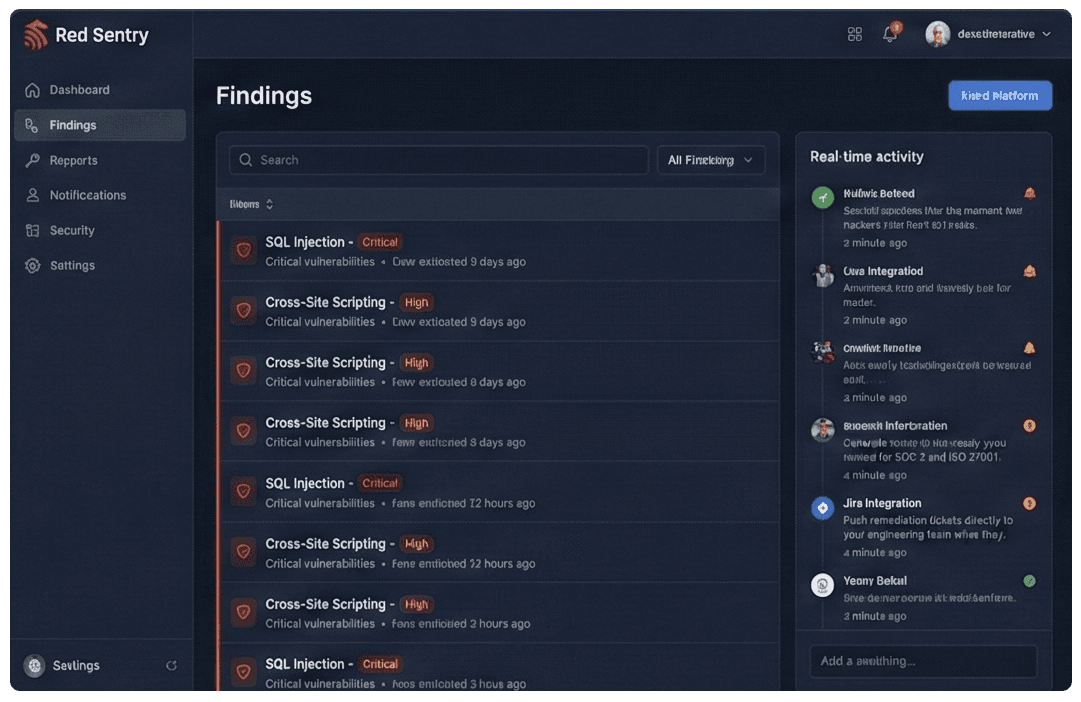
Powered by the Red Sentry PTaaS Platform
We don’t just hand you a static PDF and walk away. Every single engagement includes full access to our Penetration Testing as a Service (PTaaS) platform at no extra cost. It’s the modern way to manage your security without the headaches of email threads and spreadsheets.
Real-Time Visibility: See critical risks the moment our hackers find them so you can start fixing immediately.
Jira Integration: Push remediation tickets directly to your engineering team where they actually work.
One-Click Compliance: Generate the audit-ready reports you need for SOC 2 and ISO 27001 instantly.
Manufacturing Moves Slow. Your Security Shouldn’t.
Forget the spreadsheets and the waiting games. We give you a modern platform that keeps up with real-time threats.

Compliance and Requirements for Manufacturing
NIST CSF is the baseline framework for manufacturing cybersecurity. Defense contractors must meet CMMC requirements to handle CUI. Export-controlled manufacturers need ITAR compliance. ISO 27001 certification is increasingly required by customers and insurers. Cyber insurance now mandates security testing and OT/IT segmentation documentation.
What We Test
Our penetration tests are tailored to healthcare environments, covering the systems and workflows where breaches cause the most damage.
Industrial Control Systems & SCADA
Testing PLCs, HMIs, SCADA platforms, and industrial protocols for vulnerabilities that could disrupt production or safety.
OT / IT Network Segmentation
Assessment of segmentation to ensure attackers can’t pivot from corporate IT into production environments.
Remote Access & Vendor Connectivity
Testing VPNs, remote desktop, and vendor access paths for weak authentication, default credentials, and MFA gaps.
Manufacturing & Engineering Systems
Assessment of MES, CAD, and PLM platforms for data manipulation and IP theft risks across production and design environments.
Industrial Control Systems & SCADA
Testing PLCs, HMIs, SCADA platforms, and industrial protocols for vulnerabilities that could disrupt production or safety.
OT / IT Network Segmentation
Assessment of segmentation to ensure attackers can’t pivot from corporate IT into production environments.
Remote Access & Vendor Connectivity
Testing VPNs, remote desktop, and vendor access paths for weak authentication, default credentials, and MFA gaps.
Manufacturing & Engineering Systems
Assessment of MES, CAD, and PLM platforms for data manipulation and IP theft risks across production and design environments.
Powered by the Red Sentry PTaaS Platform
We don’t just hand you a static PDF and walk away. Every single engagement includes full access to our Penetration Testing as a Service (PTaaS) platform at no extra cost. It’s the modern way to manage your security without the headaches of email threads and spreadsheets.
Real-Time Visibility: See critical risks the moment our hackers find them so you can start fixing immediately.
Jira Integration: Push remediation tickets directly to your engineering team where they actually work.
One-Click Compliance: Generate the audit-ready reports you need for SOC 2 and ISO 27001 instantly.
Manufacturing Moves Slow. Your Security Shouldn’t.
Forget the spreadsheets and the waiting games. We give you a modern platform that keeps up with real-time threats.
Powered by the Red Sentry PTaaS Platform
We don’t just hand you a static PDF and walk away. Every single engagement includes full access to our Penetration Testing as a Service (PTaaS) platform at no extra cost. It’s the modern way to manage your security without the headaches of email threads and spreadsheets.
Real-Time Visibility: See critical risks the moment our hackers find them so you can start fixing immediately.
Jira Integration: Push remediation tickets directly to your engineering team where they actually work.
One-Click Compliance: Generate the audit-ready reports you need for SOC 2 and ISO 27001 instantly.

What you Get

Audit-Ready Reports
Reports map to SOC 2, ISO 27001, HIPAA, and PCI frameworks. Formatted to drop into auditor checklists and customer security questionnaires.
Prioritized Remediation Roadmap
Findings ranked by severity with clear fix guidance for your IT team. Technical details provided so security teams can implement fixes without disrupting patient care.
Free Retest Included
After implementing fixes, we retest at no cost to confirm vulnerabilities are resolved and provide updated documentation for compliance requirements.
What you Get
Audit-Ready Reports
Reports map to SOC 2, ISO 27001, HIPAA, and PCI frameworks. Formatted to drop into auditor checklists and customer security questionnaires.
Prioritized Remediation Roadmap
Findings ranked by severity with clear fix guidance for your IT team. Technical details provided so security teams can implement fixes without disrupting patient care.
Free Retest Included
After implementing fixes, we retest at no cost to confirm vulnerabilities are resolved and provide updated documentation for compliance requirements.

Ready to Test Your Environment?
Book a complimentary scoping call to discuss your systems, compliance requirements, and production schedule.
Ready to Test Your Environment?
Book a complimentary scoping call to discuss your systems, compliance requirements, and production schedule.